
The real cost of running TMS and SPRAVATO® services in your practice

Most mental health practices that want to offer advanced treatments for patients whose depression hasn’t responded to medication assume the hard part is buying a transcranial magnetic stimulation (TMS) machine or setting up REMS infrastructure to manage SPRAVATO® (esketamine). It isn’t. The equipment and inventory are a small part of a launch. If your practice is weighing whether to build an interventional service line in-house, you should understand what that decision involves before you commit capital and staff to it.
Big green flag: the need is there
Interventional psychiatry is shifting from a boutique offering to the mainstream. At least one in three people with depression don’t fully respond to standard treatments such as medication or talk therapy.1 For these treatment-resistant patients, FDA-approved options such as TMS and SPRAVATO® deliver meaningfully higher remission rates than another round of medication changes, with more durable relief.2
In most cases, the patients who could benefit are already on your panel. The need is there, and the only question is how you’ll build the capabilities to reach them.
What a DIY launch involves
Your DIY buildout may include buying a TMS device, certifying your site for SPRAVATO® REMS, and possibly building out a treatment room, all as overhead costs before you treat a single patient. But for most DIY practices, the bigger challenges are administrative.
Identifying the right patients. Eligibility for TMS and SPRAVATO® depends on payer-specific criteria, including diagnosis, medication history, and documented absence of contraindications. A typical EHR can’t map your patient panel against those rules, so eligible patients often go unrecognized. Practices running these programs on their own typically identify less than half of treatment-eligible patients as candidates, missing many who qualify.
Moving patients through intake. Identifying a candidate is only the first step. Each patient must be contacted, educated about treatment, and guided through consultation, screening, and scheduling. Without dedicated outreach, most patients drop off somewhere along the way.
Gaining prior authorization. Prior authorization for interventional treatments is documentation-heavy and time-consuming. Payers expect complete medication histories and clear evidence of treatment resistance. Practices that handle it in-house see approval rates less than 50%.
Keeping patients in treatment. A TMS course runs 36 sessions over seven to eight weeks, so someone has to own scheduling, no-shows, and completion for every patient. Payers also want progress documented along the way, and strong outcomes data is what supports reauthorization, retreatment, and referrals. Without a system for tracking adherence and outcomes, results are hard to demonstrate even when patients improve.
Where investment can get lost
The upfront capital is fairly visible. The ongoing costs are harder to see, and they happen at every stage of the patient journey:
- Eligibility: Practices that run eligibility through their EHR miss close to 50% of eligible patients.
- Outreach: Most practices run no proactive outreach and rely on clinicians to drive the enrollment process. Without systematic, multichannel follow-up, only about one in ten treatment-eligible patients ever reaches a clinical consult.
- Prior authorization: First-pass approval rates sit below 50% in a typical practice. Staff spend more than four hours of manual work assembling each submission, and physicians lose unpaid clinical time to peer-to-peer calls.
- Treatment completion: With no-show rates of 20% or more and nobody owning a 36-session course, adherence typically lands around 80%. Every drop-off reduces both outcomes and revenue.
Each gap impacts patients every time they can’t receive treatments that can help them. It’s also revenue lost on a service you’ve already paid to bring in-house.
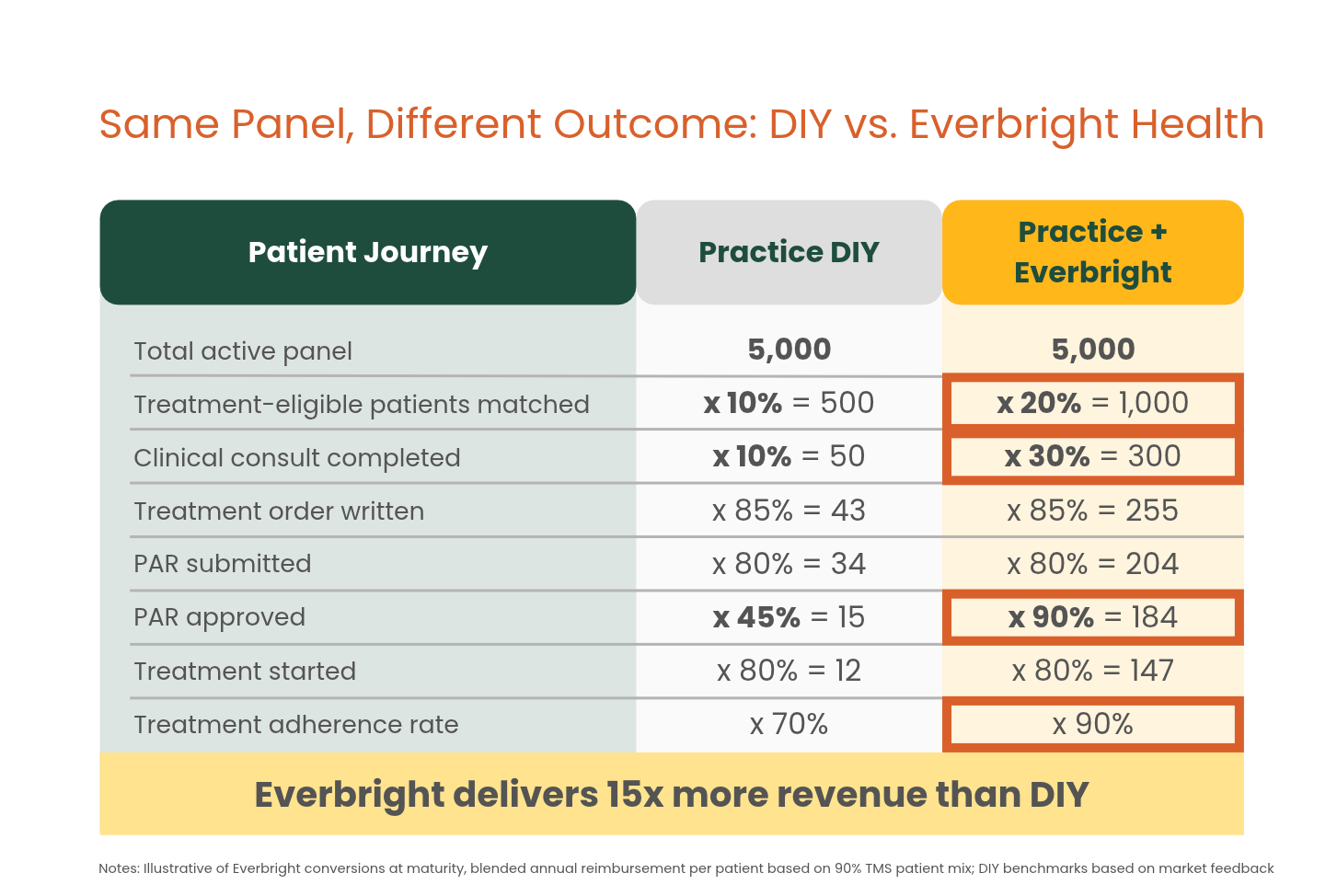
Illustrative of Everbright conversions at maturity, blended annual reimbursement per patient based on 90% TMS patient mix; DIY benchmarks based on market feedback.
Everbright let us expand what we offer our patients without disrupting anything about how we operate. We added TMS seamlessly, ramped to a full chair in a matter of weeks, and our patients now have access to interventional treatment options they previously had to go elsewhere for. It genuinely feels like an extension of our own practice.
— Paul Adams, Indiana Polyclinic
Build, partner, or wait?
One question can help you get to a decision quickly.
Do you have, or genuinely want to build, a dedicated, fully trained staff to manage eligibility scoring, prior-auth, REMS compliance, and revenue-cycle management?
If the answer is no, it’s worth modeling a partnership approach against the DIY path before you commit. An embedded model that supplies the technology, equipment, staffing, and billing changes the math considerably.
With Everbright, partner practices see more than 90% first-pass prior authorization approval, 30% of identified patients reaching a consult, 88% of patients completing their full course, and a 4.8/5.0 patient satisfaction score. Each number represents a patient who finally got a treatment that works, without having to build it all yourself.
If your practice has been thinking about offering TMS, SPRAVATO®, or other advanced treatments, we’d love to help you get there.
References
- Howes, O.D., Thase, M.E. & Pillinger, T. Treatment resistance in psychiatry: state of the art and new directions. Mol Psychiatry 27, 58–72 (2022). https://doi.org/10.1038/s41380-021-01200-3
- Reif A, Bitter I, Buyze J, et al.; ESCAPE-TRD Investigators. Esketamine Nasal Spray versus Quetiapine for Treatment-Resistant Depression. N Engl J Med. 2023 Oct 5;389(14):1298-1309. doi: 10.1056/NEJMoa2304145. PMID: 37792613.
Ready to bring advanced care to your patients?
Tell us about your practice and we'll put together a customized ROI analysis.